
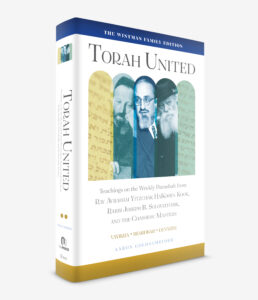
Excerpted from Rabbi Aaron Goldscheider’s Torah United: Teachings on the Weekly Parasha from Rav Avraham Yitzchak HaKohen Kook, Rabbi Joseph B. Soloveitchik, and the Chassidic Masters, co-published by OU Press and Ktav Publishing House
 Father and Sons
“You are the children of the Lord your God. You shall not cut yourself (lo titgodedu) nor make any bald spot between your eyes as a sign of mourning. For you are a holy people to the Lord your God . . .” (Deuteronomy 14:1–2). In antiquity there was a pagan practice to do out of grief precisely what is forbidden by this verse. Sometimes the meaning behind the Torah’s prohibitions eludes us, but in this case the Ramban suggested one that is quite convincing.
Jews believe in the eternity of the soul. While we naturally grieve when a loved one dies, we also know that they enjoy life on another plane. We do not despair to the point of mutilating ourselves, because such behavior only makes sense when death is chillingly final. By abstaining from such injurious outbursts of grief or anger, the Jew affirms that when the body gives out, the soul is gathered in by God.
The rationale offered by the Ramban sheds light on the descriptions that encase the prohibition: “You are the children of the Lord your God. . . . For you are a holy people to the Lord your God. . . .” Being the precious child of God who contains a spark of His holiness indicates that the Jew’s holy soul does not expire with the body.
The literal, contextual meaning of the prohibition concerns extreme expressions of mourning. The Talmud, surprisingly, grounds a different prohibition in the very same words: “lo titgodedu – you shall not make factions (agudot agudot).” The second Sochatchover Rebbe, the Shem mi-Shemu’el, was puzzled by the fact that two disparate can arise from the same words. If the Sages link them, they must share a deep connection, but what is it? What has self-mutilation for the dead to do with factionalization of the Jewish people?
We saw above that the Ramban sourced the reason for the commandment to recognition of the everlasting soul. The Sochatchover went a step further: the souls of the living and of the departed remain in contact, on some level. The goodbye is neither complete nor for forever. He then extended this rationalization to the case of infighting. To do battle, whether physical or verbal, against fellow Jews is to be oblivious to the divine soul inhabiting all of us. Our physical features diverge, but spiritually we are made of the same stuff. When the Torah forbids the splintering into factions, we are being bidden to remember that every single Jew has the same soul-root and shares a unified spiritual existence. The rabbinic interpretation of lo titgodedu is not an arbitrary projection onto the text, but a conceptual outgrowth of the original prohibition.
The importance of peeling away the physical exterior to perceive the sacred soul inherent in our neighbor is one of Chassidut’s most celebrated teachings. One of the greatest and original expositions of this can be found in the Alter Rebbe’s Tanya. There, we learn that if we deemphasize the physical, it becomes easier to see the value in others and to commensurately love them for who they really are. In the Alter Rebbe’s words:
The entire Jewish people are called brothers in the literal sense, on account of their common soul-root in the one God, it is only their bodies that are distinct. Therefore, true love and fraternity cannot exist among those who make the body primary and the soul secondary; it must perforce be based on other factors.
If we focus on the soul, on the sanctity, and on the righteousness of others, love will come naturally. If we are all children of God, as Parashat Re’eh teaches, then we are ipso facto all brothers and sisters.
Our status as God’s children is essential and immutable. Such is the opinion of Rabbi Meir, based on four different verses. No matter what we do, even if we break the covenant, God is still our Father. Rabbi Yehudah begged to differ and limited the filial relationship to when we are on our best behavior. Rabbi Tzvi Yehudah Kook noted that Rabbi Yehudah is usually granted the last word in disputes with Rabbi Meir, but in this case Rabbi Meir is correct. Like the biological relationship between parent and child, we are God’s inalienable children.
The inseverability of this bond is indicated by the use of direct address in the verse: “You ( אתֶַּם ) are the children of the Lord your God.” Rebbe Mordechai Twersky of Kozmir made this point rhetorically by comparing it with another instance where the Sages highlighted its use. Concerning the holidays, the Torah writes “which you will designate (אֲשֶׁר תִּקְרְאוּ אֹתָם)” (Leviticus 23:4), that is, the Jewish people decide the date of the holidays through the declaration of the New Moon. The Sages reread this phrase homiletically as “which you will designate as you are” ( אשֲׁרֶ תִּקרְְאו אתֶַּם ) – even if you are mistaken or intentionally miscalculating. How much more so here, said Rebbe Mordechai, when the Torah says “you” ( אתֶַּם ) outright, it must mean in whatever state the Jewish people are in. No matter what, we are God’s children.
The fact that we are “children of God” means that God is our Father. The end of the Book of Deuteronomy states this outright: “Is He not your Father?” (Deuteronomy 32:6). On Rosh Hashanah, when the entire world is judged, we sing festive tunes and have elaborate feasts. Where is the dread of judgment? The Chassidim answer that the judge before whom we stand on these holy days is none other than our Father.
Chassidut insists on the need to convey to every single Jew, no matter their level of commitment or observance, how much they count in God’s eyes. A contemporary Chassidic teacher once quipped, “I am convinced that most Jews believe in God, but do most Jews realize how much God believes in them?” This is what Moshe sought to teach the Jewish people when he exclaimed, “You are the children of the Lord your God.”
Being the children of our heavenly Father also casts the Torah in a new light. Rabbi Zalman Sorotzkin, an outstanding Polish rabbinic leader who fled to Mandate Palestine during World War II, recounted a story from his trip to the Holy Land. He shared a cabin on the ship with a Jewish magnate who had renounced his observance and belief. For three days Rabbi Sorotzkin worked on him, and by the fourth day the rich atheist conceded that he now believed in God. Still, he refused to believe in the divine origin of the Torah. Although Rabbi Sorotzkin knew that he could convince him of that as well, given enough time, the ship was rapidly approaching the Jaffa shore. There was nothing left to do but go on deck to behold the Holy Land.
As they stood next to each other, Rabbi Sorotzkin asked him, “Do you have any children?”
He answered that he had a son in university and a daughter in high school.
The rabbi pressed him, “Why burden them with all that studying? You have a big business and plenty of money, enough to keep them wealthy for the rest of their lives. [ . . . ] Why trouble them with all this schooling? Would it not be better to allow them to stay home and enjoy themselves?”
The man, somewhat disturbed, quickly responded, “They are my children! I have to educate them; otherwise, they will be uncivilized boors.”
Rabbi Sorotzkin was quite pleased and got the final word, “Let your ears hear what your mouth has said. It is a father’s obligation towards his children not only to provide them with food, clothing, shelter, and even wealth . . . he must also teach them wisdom and understanding. [ . . . ] If you, a flesh and blood father, understand enough to provide this for your children, then how very much more does the Father of mankind understand! So He gave us the divine Torah, heavenly wisdom which keeps us on the straight path. . . .”
May we merit making our Father proud by following His detailed instruction.
