
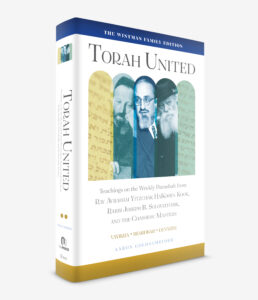
Excerpted from Rabbi Aaron Goldscheider’s Torah United: Teachings on the Weekly Parasha from Rav Avraham Yitzchak HaKohen Kook, Rabbi Joseph B. Soloveitchik, and the Chassidic Masters, co-published by OU Press and Ktav Publishing House
 Confessing One’s Good Deeds
Vidui (confession) is so integral to the process of teshuvah (repentance), to the breast-beating and soul-searching that commences in Elul and culminates in Yom Kippur, that we tend to associate it with that and that alone. But Parashat Ki Tavo features a vidui of an utterly different kind: vidui ma’aser. In the fourth and seventh years of the sabbatical cycle, we make a declaration that we have properly fulfilled the mitzvot of taking and apportioning tithes:
I have removed all of the holy from the house, and I have also given it to the Levite, the stranger, the orphan, and the widow. In accord with all of Your commandments that you have commanded me, I have neither transgressed any of Your commandments nor forgotten. . . . I have hearkened to the voice of the Lord, my God; I have done according to all You commanded me. (Deuteronomy 26:13–14)
The Sages called this declaration a vidui. What does that mean in a context where there is specifically no wrongdoing?
Rav Avraham Yitzchak Hakohen Kook offered a beautiful answer. Confession, at its heart, is self-appraisal. Any honest assessment includes the good and the bad, the pros and the cons. Often we err in laying too much emphasis on our misdeeds and too little on our good deeds, which can ruin our mental and spiritual health. To avoid over-criticism, we must also recognize our positive acts and choices. Our relationship with God revolves as much around virtue as it does sin.
When Rav Kook was still an adolescent prodigy of eighteen, he heard that Rabbi Yisrael Salanter, founder of the Musar movement, had died. He immediately carried out the rituals of mourning that apply when a great Torah figure passes. Although Rav Kook had the greatest admiration for Rabbi Salanter’s program of Musar, he voiced concerns. He felt that policing one’s actions and thoughts on a constant basis and thinking lowly of oneself could be too emotionally taxing and stunt, or even reverse, spiritual growth. Torah study and mitzvah observance, Rav Kook firmly believed, should be pursued with good cheer and equanimity.
Rav Kook was deeply drawn to the teachings of Rebbe Nachman of Breslov, for whom self-worth and hope were central. In a celebrated discourse, Azamerah lelohai be-odi, based on the verse, “I shall sing to my God as long as I am” (אֲזַמְּרָה לֵא־לוֹהַי בְּעוֹדִי) (Psalm 146:2), the rebbe urged his readers to find the good in themselves:
Just as we must judge others favorably, even the wicked, to find in them good elements . . . so must a person do for himself, to judge himself favorably, and to find some element of good, in order to strengthen himself so he does not completely collapse. On the contrary, he will revive himself, and gladden his soul with the modicum of good that he finds in himself.
Rebbe Nachman read the verse to mean “I shall sing to my God with my od,” my little ounce of goodness. He compared this to a song that joins notes to create a tune. We, too, should put together our points of goodness to produce our very own song for God. Feelings of pride and self-worth propel us forward in our spiritual life, and are essential for our own happiness.
We must believe in ourselves, for God has faith in us as well. Rabbi Zalman Sorotzkin cited the Rizhiner Rebbe, who commented on a line we say on Rosh Hashanah: “You remember everything forgotten (וזְוכֵֹר כָּל הַנשְִׁכָּחותֹ).” While most of us think the forgotten deeds are our sins, the rebbe suggested that it refers to our good deeds. We might tend to minimize these and forget all about them, but God remembers “everything forgotten.”
The parashah that contains the vidui ma’aser is always read in the run-up to the Days of Awe. It is an important reminder that in the same way God does not forget any of our bad deeds, so too he does not forget or underplay a single good deed. As our next year hangs in the balance, we ourselves must preserve an internal balance, keenly pained by our shortcomings while healthily aware of our strong points.
