
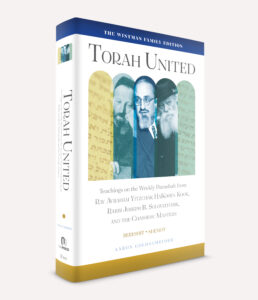
Excerpted from Rabbi Aaron Goldscheider’s Torah United: Teachings on the Weekly Parasha from Rav Avraham Yitzchak HaKohen Kook, Rabbi Joseph B. Soloveitchik, and the Chassidic Masters, co-published by OU Press and Ktav Publishing House
 Holy and Whole
After a prolonged, arduous journey, Yaakov finally returns home to the land of Canaan (Genesis 33:18). Having escaped from the house of Lavan and survived the encounter with his adversarial brother Esav, he finally can settle into a new chapter of life. The Torah chooses a single word to encapsulate Yaakov’s current physical, emotional, and spiritual state: shalem.
Rashi noted that, on the whole, Yaakov emerged from all the scrapes and struggles shalem, in the sense of intact or unbroken. “He was shalem in body, for his limp had healed. He was shalem in money, for he lost nothing on account of the tribute. He was shalem in Torah, for he forgot none of his learning in the house of Lavan.” Despite the stream of never-ending problems – one thing after the next – every aspect of Yaakov’s existence in this world remained intact. In fact, he only came out stronger.
Rav Avraham Yitzchak Hakohen Kook expanded upon Rashi’s idea. Wholeness in body, finances, and spirit reflects Yaakov’s capacity to live a holistic life. He is now able to weave together the various threads of his life – the physical, financial, and intellectual-spiritual – so that they all share in the pursuit of the noble and the good. Yaakov reaches a stage in life in which he seamlessly integrates all aspects of his life into divine service. He is shalem in the sense of being made whole, of synthesizing the physical and the spiritual.
We learn from Yaakov that the physical and financial need not be in conflict with the spiritual. To the contrary, these elements are thevery foundations of a well-rounded, complete life, a life that is shalem. Yaakov embodies the notion that to live religiously is to let the spiritual into every area of our lives.
There is nothing neutral in life; every aspect can be directed to God. From this perspective, the seemingly mundane – eating, sleeping, conducting business – is no less part of God’s service than the ritual observances of prayer, Torah study, and giving charity.
The Torah commands the entire Jewish people, “You shall be tamim with the Lord your God” (Deuteronomy 18:13). Contextually, this is understood to mean that one must have faith in God alone and not engage in illicit practices, such as magic, divination, or communing with spirits. Targum Onkelos, however, translates tamim as shelim, the Aramaic equivalent of shalem. According to this, tamim does not mean “pious” or “innocent,” but “well-rounded.” Perhaps the Torah foreshadows this unique aspect of Yaakov’s character when we are first introduced to him as an ish tam (Genesis 25:27).
Impressively, Yaakov was not satisfied with his own spiritual attainment and endeavored to teach it to others. The very same verse which calls him shalem tells us that he provided assistance to the city where he settled. The Sages instruct that “he encamped facing the city” ( ויַחִַּן אֶת פְּנֵי הָעִיר ) (Genesis 33:18) should be understood roughly as “he generously improved the face of the city.” What kindness did he do for the city of Shechem? He established a monetary system, set up a marketplace, or erected bathhouses. These contributions were not merely a reflection of his philanthropy. Yaakov was convinced that the underpinnings of ethical life begin with ennobling every sector of society. He implemented and modeled for others his conception of an integrated spiritual life.
What drove Yaakov to promote religious values and faith among non-Jews? Apparently, he felt responsible for the world as a whole.
Rav Kook writes that part of actualizing our national shelemut is the responsibility of disseminating our wisdom to the world:
The strength of the desire to be good to everyone in the world without limitation, both in the amount of good to those in need of it, and in the quality of the good – this is the inner seed of the soul of the Community of Israel. This is the inheritance and the legacy from our ancestors, and this is the secret of the longing for redemption that is in the nation. . . .”
The proposition that we can sanctify every aspect of our lives forms the bedrock of Jewish tradition. For example, financial success need not be a hindrance to spiritual growth. If used properly, money can be its catalyst. The heavy gauntlet Yaakov throws down is to infuse every aspect of our lives with holiness and nobility.
